Rethinking the Running Wheel
running wheel, treadmill, head-fixed, sniff rate, calcium imaging, low-profile
The problem with standard wheels
Most head-fixed rigs today converge on the same running wheel: smooth, large-diameter, low rotational friction. It’s a good wheel — mice can accelerate on it with almost no effort.
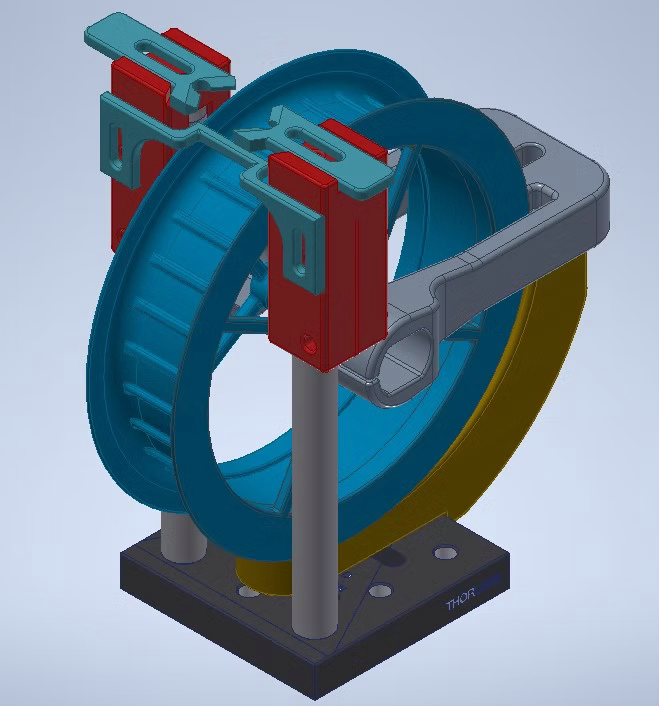
Issue one: wheel height and the goniometer problem
The first issue was mechanical, not behavioral. Standard wheels sit high, and a tall wheel means that any tilt correction applied through a goniometer translates into a large lateral shift of the animal.
Why tilt at all? Because in practice the cranial window and the headbar are rarely perfectly parallel — it’s some combination of a non-flat skull and headbar placement during surgery. Correcting for that with a goniometer is routine, but doing it on top of a tall wheel amplifies a small angular correction into a large positional one, which fights against keeping the animal centered under the objective.
Issue two: sniff rate and running speed
The second issue is behavioral. Speeding up on a smooth, low-friction wheel drives fast, shallow inhale-exhale cycles, and once sniff rate climbs above ~5 Hz it stops being a clean reference for anything downstream. For calcium imaging in particular, that’s a bad combination: you want sniffing slow and stable enough to resolve odor-locked dynamics, not a mouse sprinting through several sniff cycles a second.
In practice, this is why we mostly end up locking the standard wheel entirely for passive odor presentation or 2P single-cell holography — mice can run fast enough on it that letting it spin freely defeats the point of the experiment.
Looking for something low-profile
Both problems pointed the same direction: a low-profile wheel that doesn’t invite the animal to run fast and doesn’t compound tilt corrections into large lateral shifts.
My PI, Dima Rinberg, pointed me to the design his lab used in:
Resulaj A, Rinberg D. Novel behavioral paradigm reveals lower temporal limits on mouse olfactory decisions. Journal of Neuroscience, 35(33):11667–11673 (2015). DOI 10.1523/JNEUROSCI.4693-14.2015
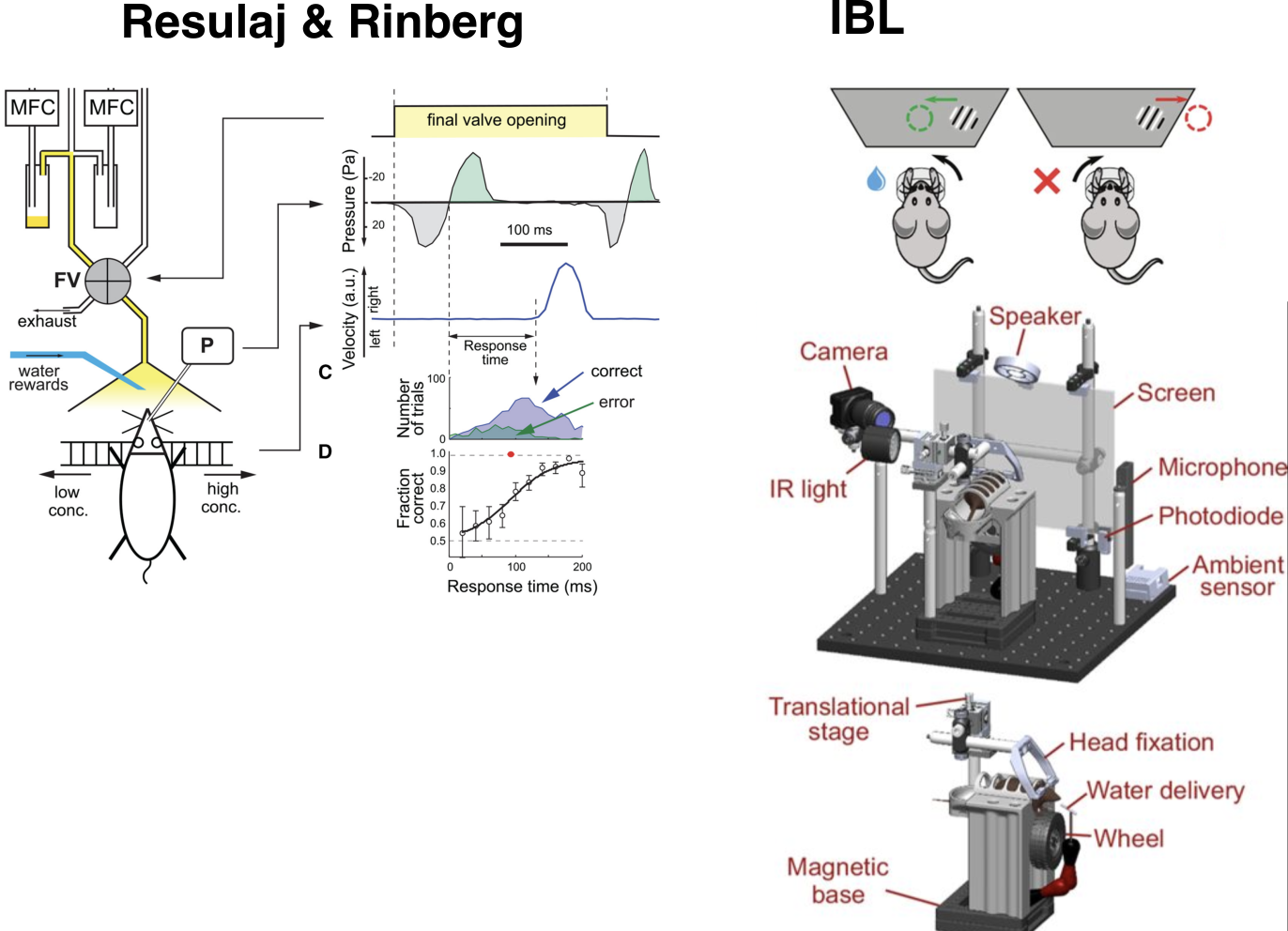
Their apparatus was a deliberately simple, low-profile treadmill — built from Lego parts (belt, wheels, axles) on a custom frame — designed around a horizontal, front-limb-driven choice interface rather than a tall, freely spinning wheel.
For context, here’s that original Resulaj & Rinberg design alongside the International Brain Laboratory’s visual decision-making rig. The two look quite different at first glance, but the IBL wheel design actually traces back to Resulaj & Rinberg as well — per Ken Harris’s 2024 talk at the NYU Langone Neuroscience Seminar:
Building it with Tim
I was busy with other parts of the project, so I needed someone to turn the idea into an actual 3D drawing. Our research technician at the time — Tim Reizis, now a PhD student in the lab — did that CAD work and translated the concept into reality.
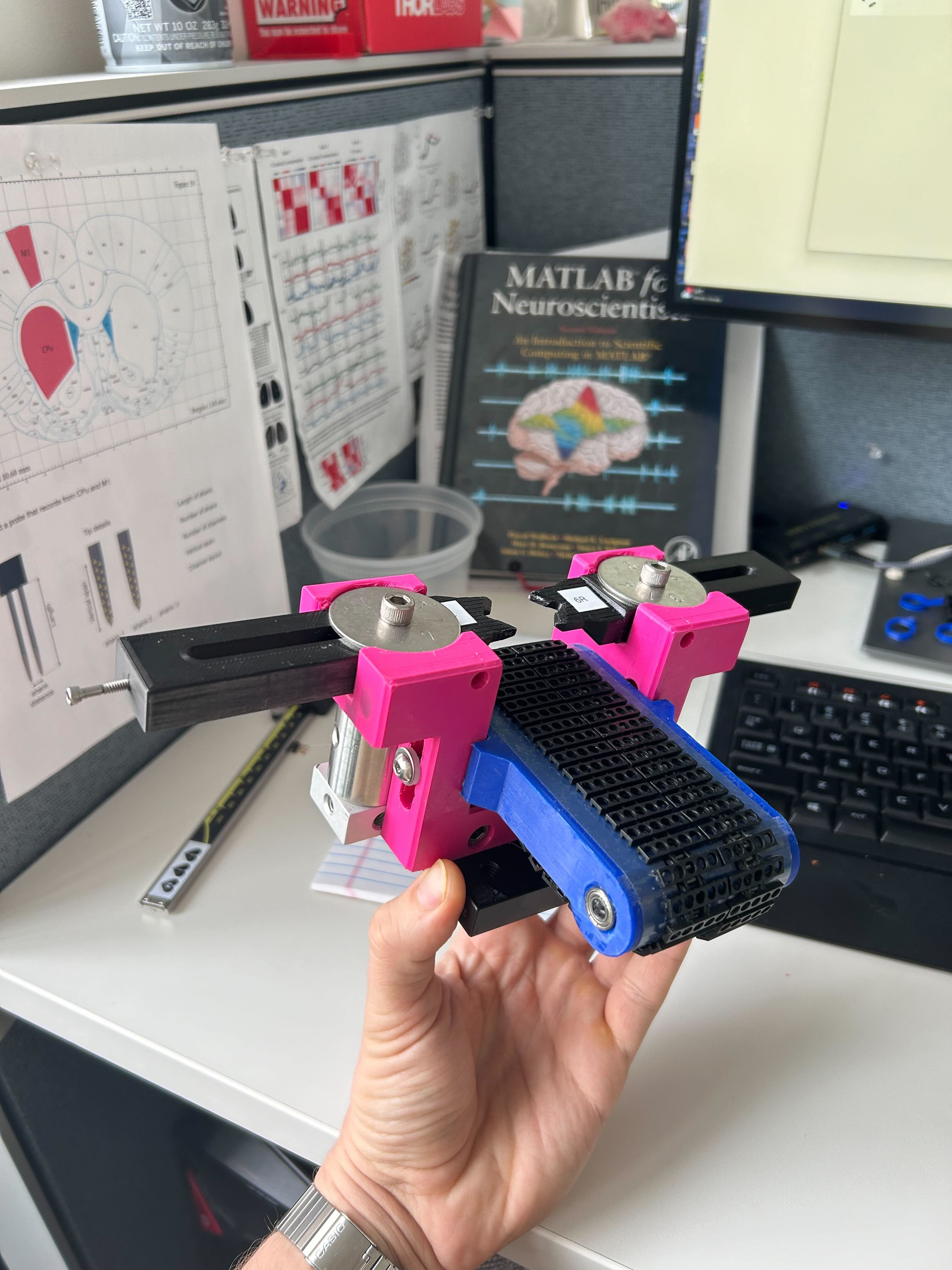
This low profile is what actually solves the second problem from the top of this post: with a high-profile wheel, any goniometer tilt applied to correct a non-parallel cranial window/headbar gets amplified into a large lateral shift of the animal. Keeping the wheel — and the animal — close to the tilt axis means the same correction no longer pushes the mouse out of position under the objective.
The last phase: building it with Misi
The final phase of this story came later, working with my friend Mihaly (Misi) Vöröslakos, from the Buzsáki lab, who was independently looking for a low-profile wheel for his own head-fixed electrophysiology recordings. Starting from the same Resulaj & Rinberg-inspired base, we made a couple of changes together:
- Headcap compatibility — reworked the mouse cover/clamp geometry so the treadmill works with Misi’s headcap design, not just ours.
- Speed measurement — added a rotary encoder to the treadmill axle so running speed is read out directly, rather than just providing a low-profile surface to run on.
His version is hosted here: misiVoroslakos/3D_printed_designs — Treadmill_Rinberg
Our version (built for imaging rather than ephys) is here: olfa-lab/Imaging-Treadmill
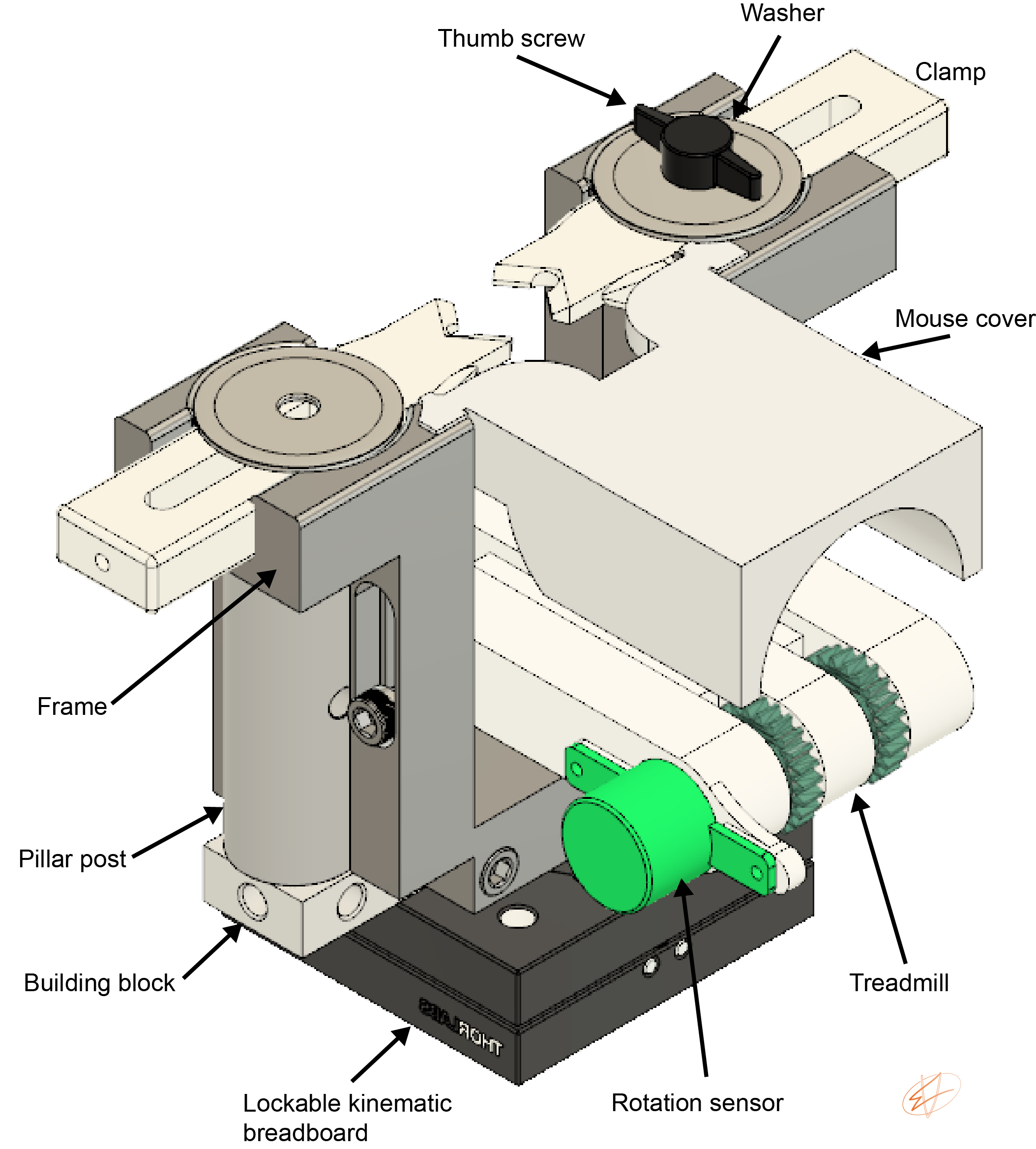
The next post will cover final dimensions, materials, and how the build performs against the two original problems — sniff rate and tilt-induced lateral shift.
Interested in the build details before the next post goes up? Get in touch.